-
bitradex
- No Comments
If you trade BTC/USDT futures long enough, margin mode stops being a settings detail and starts becoming a risk decision.
Most traders notice leverage first. They notice entry price second. Margin mode usually gets less attention than it deserves. But in practice, the choice between cross margin and isolated margin changes how your collateral is used, how liquidation risk spreads, and how much of your account can be affected by one bad trade. That is why major exchange education pages treat it as one of the core mechanics of leveraged futures trading.
For BTC/USDT futures, the difference is simple at a high level: cross margin shares more of your account across positions, while isolated margin limits risk to the collateral assigned to one position. The real question is how that difference affects your actual trading.
What margin means in BTC/USDT futures
Before comparing the two modes, it helps to clarify what margin is.
In leveraged futures trading, margin is the collateral supporting a position. It is the amount of funds backing the trade rather than the full notional value of the position. CoinMarketCap’s explainer frames margin as the trader’s collateral in a leveraged trade, and BitradeX’s futures guide describes USDT-M futures as contracts where USDT is used as the margin and settlement currency.
So in BTC/USDT futures, you are not usually paying the full value of the BTC exposure upfront. You are posting margin, choosing leverage, and letting that structure amplify both gains and losses. Margin mode determines how that collateral is allocated when the trade is live.
What is cross margin?
Cross margin uses the available balance in the relevant margin account more broadly to support open positions.
BitradeX’s app guide defines cross margin as using the entire account balance as margin for positions. CoinMarketCap similarly says cross margin uses your whole account balance to margin trades, and Flipster describes it as shared collateral across all positions.
The practical effect is that if one BTC/USDT position starts losing money, more funds from the broader account may be used to keep it alive longer. That can reduce the chance of immediate liquidation on that one position, but it also means more of the account can be affected if the trade continues to go wrong.
What is isolated margin?
Isolated margin assigns a specific amount of collateral to a specific position.
BitradeX defines isolated margin as allocating collateral only to a specific position. CoinMarketCap, HashKey, and LBank all describe isolated margin in similar terms: the loss is contained to the margin assigned to that position, and liquidation affects that position rather than automatically pulling in the rest of the account balance.
That makes isolated margin easier to understand as a risk-control tool. If you allocate 100 USDT to one BTC/USDT futures position in isolated mode, that position can only consume that defined margin allocation under the platform’s margin rules, rather than automatically drawing from the rest of the account.
The core difference in one sentence
A simple way to remember it is this:
- Cross margin = shared risk across more of the account
- Isolated margin = ring-fenced risk on one position
That is the short version. The more important version is what this means for liquidation, capital efficiency, and trader behavior.
How liquidation risk changes between the two
This is where the distinction becomes real.
With cross margin, a losing BTC/USDT position can survive longer because more account collateral may support it. That can reduce early liquidation risk on that position. But the trade-off is that a severe loss can spread damage across more of the account. CoinMarketCap explicitly warns that cross margin can put the whole account at greater risk in liquidation scenarios, while Flipster notes that one large loss can affect all positions in the shared margin pool.
With isolated margin, liquidation typically affects only the margin allocated to that specific position. That is why HashKey and LBank describe isolated margin as having better independent risk control but lower capital efficiency.
So the trade-off is straightforward:
- cross margin can provide more breathing room,
- isolated margin can provide tighter damage control.
Why beginners often prefer isolated margin
For most newer BTC/USDT futures traders, isolated margin is usually easier to manage.
The reason is not that isolated margin is always “better.” It is that the risk is clearer. If the trade fails badly, the maximum exposure is more tightly linked to the capital assigned to that one position. HashKey calls this independent risk control, and CoinMarketCap’s beginner explanation makes the same case through examples.
In practice, isolated margin helps beginners avoid one common mistake: accidentally allowing a single overleveraged BTC/USDT position to threaten much more of the account than intended. That is why isolated margin is often recommended as the more controlled starting mode for directional speculation.
Why some traders use cross margin instead
Cross margin still has real advantages.
The biggest one is capital efficiency. LBank and Flipster both note that cross margin allows funds to be shared more flexibly across positions. Profits or excess collateral from one position may help support another position that is under pressure.
That makes cross margin more attractive for traders who:
- run multiple positions,
- hedge one exposure against another,
- want to avoid an isolated position being liquidated too early,
- actively manage account-wide collateral rather than trade-by-trade collateral.
This is a more advanced workflow. The advantage is flexibility. The cost is that mistakes can spread more easily.
BTC/USDT futures examples
A practical example makes the difference clearer.
Imagine you open a BTC/USDT long using isolated margin and assign 100 USDT to the trade. If the position moves badly enough to reach liquidation under the exchange’s rules, the loss is mainly contained to that isolated margin amount rather than automatically reaching across the rest of the account. CoinMarketCap and HashKey both use versions of this logic in their teaching examples.
Now imagine the same BTC/USDT long in cross margin mode. If the position starts losing money, the system may draw on broader account balance to support it. That can delay liquidation, but it also means the account-wide risk is larger if the move continues against you.
That is why cross margin is not just “more protection.” It is more shared exposure.
How this appears in the BitradeX BTC/USDT setup
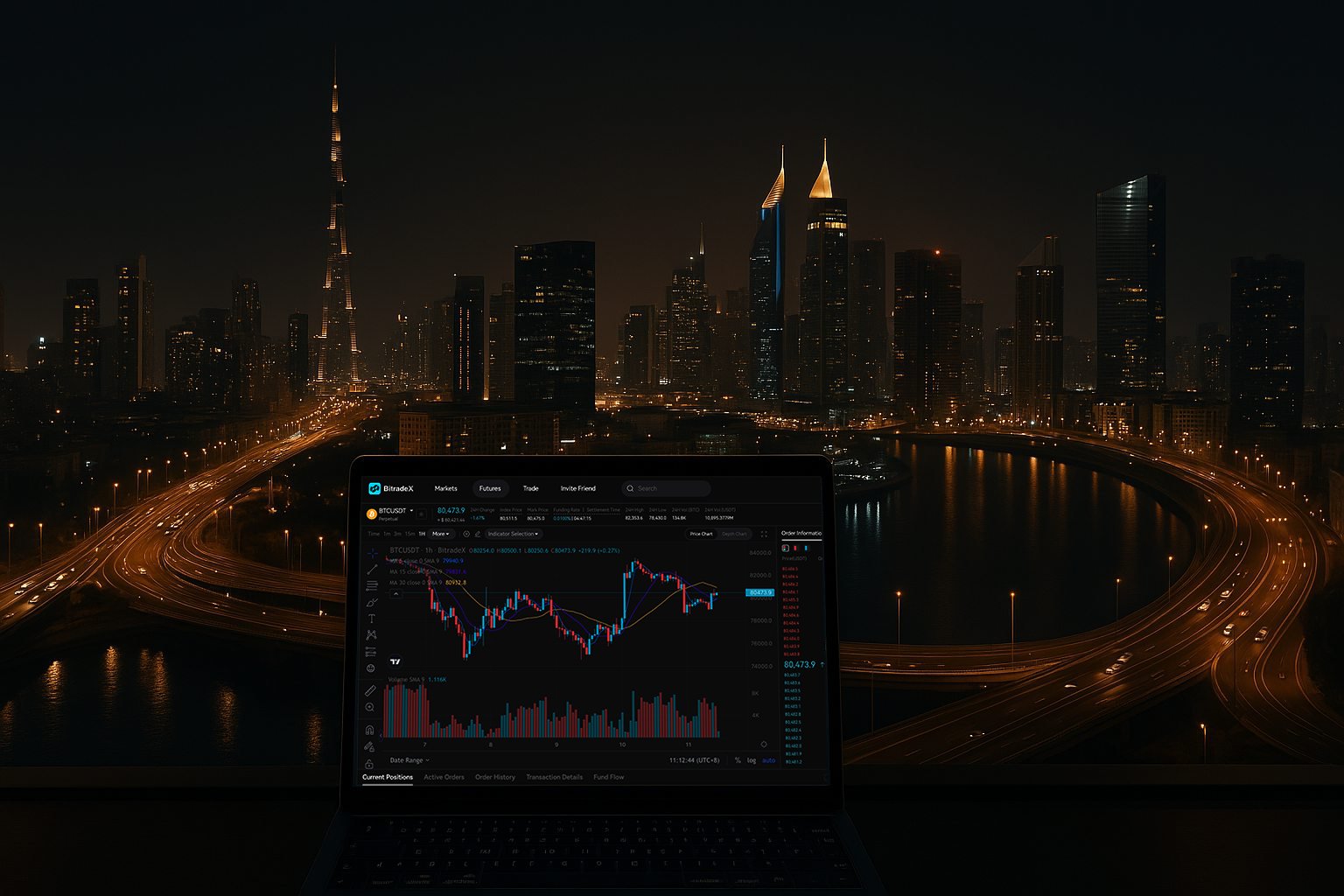
BitradeX’s current contract information page lists BTC/USDT as a linear, USDT-margined, perpetual contract that supports both cross and isolated margin, with 0.0001 contract size, 0.1 minimum tick size, and up to 125x leverage. Its app guide also tells users to choose margin mode before placing the trade.
That is the right operational design for an educational article on this topic, because margin mode should be visible during order setup rather than hidden behind advanced menus. A fair small caveat is that very advanced traders may still want more portfolio-level analytics around total account exposure, but the core BTCUSDT futures workflow itself is presented clearly.
Which one is better for BTC/USDT futures?
There is no universal winner.
Isolated margin is usually better when:
- you want strict control over one position,
- you are newer to BTC/USDT futures,
- you do not want one trade to threaten more of your account,
- you are running straightforward directional trades.
Cross margin is usually better when:
- you understand account-wide exposure,
- you are managing multiple positions,
- you value collateral efficiency,
- you are comfortable with shared-risk structure.
That is why many educational sources do not say one is always superior. They say each margin mode fits a different risk style.
Common mistakes
The first mistake is choosing cross margin without realizing it can expose much more of the account than expected. CoinMarketCap and Flipster both warn about this directly.
The second mistake is choosing isolated margin and then assuming that makes leverage harmless. It does not. Isolated margin contains risk better, but an overleveraged BTC/USDT position can still be liquidated quickly. HashKey and LBank both note that isolated margin can mean lower capital efficiency and faster liquidation if the position itself is underfunded.
The third mistake is treating margin mode as a default setting instead of a trade-design decision. In BTC/USDT futures, it is part of the strategy.
A practical rule of thumb
For many traders, a simple rule works well:
Start with isolated margin while learning BTC/USDT futures, especially for single-position directional trading. Move to cross margin only when you understand how account-level exposure, shared collateral, and multiple-position management actually work. This is an inference drawn from the trade-offs emphasized across the educational sources, rather than a direct rule from one exchange.
That rule is not perfect, but it lines up with how the risks are distributed.
Conclusion
Cross margin and isolated margin are two different ways to manage collateral in BTC/USDT futures.
Cross margin uses more of the account as shared support, which can improve flexibility and delay liquidation on a position, but it can also spread losses more widely. Isolated margin limits risk to the collateral assigned to one position, which makes it easier to contain damage, though it may reduce capital efficiency and can liquidate faster if the isolated allocation is too small.
That is why the better question is not “Which one is best?” but “Which one fits how I want risk to behave?” For many BTC/USDT traders, that is the decision that matters most.

No Comments